
Verified compound transparency is defined as the practice of linking batch-specific analytical documentation directly to a research compound, confirming its identity, purity, and potency before use. For researchers working with peptides and other research-grade materials, this documentation standard is the difference between reproducible data and wasted experiments. Independent testing has found impurity levels as high as 86% in unverified injectable preparations. That figure alone explains why the compound verification process has become a non-negotiable standard for serious scientific work. The benefits of verified compound transparency extend from procurement through data interpretation, and every stage of your research depends on getting this right.
1. What are the primary benefits of verified compound transparency?
The compound transparency advantages researchers gain from verified documentation fall into five clear categories. Each one directly affects the quality of your experimental outcomes.
- Accurate compound identity: A batch-specific Certificate of Analysis (COA) confirms the active ingredient matches the label claim. Without this, you cannot rule out substitution or mislabeling.
- Known potency: USP standards require potency to fall within 90–110% of label claim. Results outside that range signal compounding failures or instability that will corrupt your dose-response data.
- Contamination control: Verified COAs document sterility, endotoxin levels, and residual solvents. These are the impurities most likely to confound cellular assays and metabolic studies.
- Reproducibility: When every batch carries matching lot documentation, you can replicate conditions across experiments and compare results with confidence.
- Supplier accountability: Transparent sourcing creates a paper trail. Suppliers who publish third-party lab data take responsibility for their materials in a way that anonymous vendors cannot.
Pro Tip: Always cross-reference the batch number printed on the vial label against the batch number on the COA document. A mismatch means the document does not apply to your material, regardless of how clean the numbers look.
Verified compound benefits go beyond individual experiments. When your entire team sources from verified suppliers, you build a shared documentation standard that makes internal audits and external peer review far easier to manage.

2. How does verified compound transparency enhance quality control?
Quality control in compound sourcing depends on linking lot-specific test results directly to the material in your hands. A batch-linked COA includes active ingredient identity, potency percentage, sterility results, and endotoxin test data. Each data point corresponds to the exact production run, not a generic product profile.
The compound verification process works through a structured sequence:
- Lot assignment: The supplier assigns a unique lot number to each production batch before testing begins.
- Third-party analytical testing: An independent laboratory performs HPLC, mass spectrometry, and microbial testing on the batch.
- COA generation: The lab issues a document tied to that specific lot number, recording all test results with pass/fail determinations.
- Batch number matching: The lot number on the COA must match the number on the product label and the supplier’s website record. Matching batch numbers on all three sources is the minimum standard for trust.
- Out-of-specification detection: Any result outside the accepted range triggers a hold or rejection before the material ships.
“Transparency should be structured to reduce uncertainty, providing clarity about knowns and next steps, rather than overwhelming users with raw data.” — Antoine Buteau, Trust That Actually Compounds Series
This point matters practically. A supplier who publishes every test result in an unorganized data dump is not actually transparent. Structured documentation, organized by lot number with clear pass/fail indicators, is what allows you to validate a compound in under five minutes rather than spending an hour parsing raw instrument output.
3. Verified versus unverified compounds: risks and consequences
The gap between verified and unverified compounds is not a matter of degree. It is a categorical difference in research reliability.
Impurity levels documented at 75% in oral preparations and 86% in injectables represent materials where the unknown content outweighs the labeled compound. Running an experiment with such a material does not test your hypothesis. It tests an undefined mixture.
| Factor | Verified compounds | Unverified compounds |
|---|---|---|
| Identity confirmation | Confirmed by third-party HPLC or MS | Unknown or self-reported only |
| Potency range | Documented within 90–110% USP standard | Undocumented, potentially far outside range |
| Impurity profile | Residual solvents and byproducts quantified | Unknown byproducts present at any level |
| Sterility status | Tested and documented per batch | Not tested or not disclosed |
| Traceability | Lot-specific COA with test dates | Generic or absent documentation |
| Reproducibility risk | Low, batch data supports replication | High, no baseline for comparison |
The consequences of using unverified materials compound over time. A single contaminated batch can invalidate months of data. More damaging is the scenario where contamination is not detected, and flawed conclusions enter the scientific record. Deviations beyond established potency ranges signal quality failures that directly impact experimental reproducibility and validity.
Verified compound transparency mitigates these risks by making the quality profile of every batch visible before you commit it to an experiment.
4. Which technologies and platforms are advancing compound transparency in 2026?
The importance of compound transparency has driven the development of dedicated verification infrastructure. Several platforms now give researchers direct access to batch-level documentation without relying solely on supplier claims.
- MSG Trace: Metabolic Supply Group launched MSG Trace as the first industry-wide transparency platform for compounded materials. The platform provides public access to lot-specific COAs, potency data, sterility results, and sourcing information. Researchers can verify quality independently, without contacting the supplier.
- Authentication codes: Some vendors now print unique authentication codes on product packaging. Scanning the code pulls the corresponding COA from a third-party database, making document forgery significantly harder.
- Published batch COA libraries: Vendors who maintain searchable archives of historical COAs allow researchers to audit consistency across production runs. Over 300 batch-level COAs with authentication codes represent the current best-practice benchmark for transparent vendors.
- Standardized documentation formats: Platforms that enforce consistent data fields across suppliers make cross-vendor comparison possible. Researchers can evaluate potency, purity, and sterility results side by side rather than reconciling incompatible formats.
Pro Tip: When evaluating a new supplier, request COAs for three consecutive lots of the same compound. Consistency across batches tells you more about manufacturing quality than any single perfect result.
Organizations that institutionalize comprehensive transparency around compound quality build long-term trust, making them preferred scientific partners. Platforms like MSG Trace raise the floor for the entire industry by making opacity harder to sustain commercially.
Transparency also enables researchers to make informed procurement decisions, and that shift elevates sourcing standards across the field. When researchers can compare verified batch data across suppliers, the market rewards quality rather than just price.
Key takeaways
Verified compound transparency is the single most effective safeguard against experimental failure caused by impure, mislabeled, or unstable research materials.
| Point | Details |
|---|---|
| Batch-specific COAs are non-negotiable | Generic product COAs do not validate the specific lot in your hands. |
| Impurity risk is severe without verification | Unverified compounds have shown impurity levels as high as 86%, invalidating experimental data. |
| Potency must fall within 90–110% | Results outside USP range signal compounding failures that corrupt dose-response experiments. |
| Batch number matching is the minimum check | The lot number on the label, the COA, and the supplier record must all agree before use. |
| Structured transparency beats raw data | Organized, lot-linked documentation lets you validate a compound in minutes, not hours. |
Why I think most researchers underestimate the transparency problem
The research community talks a great deal about reproducibility, and yet the conversation almost never starts at the source material. I have seen labs spend weeks troubleshooting assay variability, adjusting protocols and swapping reagents, only to discover the root cause was a batch of peptide that never matched its label claim. The experiment was not broken. The compound was.
What strikes me most about the current state of compound sourcing is how much trust researchers extend to suppliers based on nothing more than a polished website and a PDF with no lot number. A COA without a matching batch number is not a quality document. It is a template. The distinction matters enormously, and it is one that structured transparency practices make obvious once you know what to look for.
The other thing I have observed is that transparency around failure is actually more credible than a perfect track record. Suppliers who publish out-of-specification batches and explain what went wrong demonstrate that their quality system is real. A vendor with zero documented failures either has extraordinary manufacturing consistency or is not testing rigorously enough to catch problems. I know which explanation is more common.
My recommendation to any research team is to treat compound documentation as part of your experimental design, not an afterthought. Before you run a single assay, confirm the lot number, check the test date, and verify the potency result falls within the accepted range. That five-minute check protects months of work.
— Paul
Verified compounds and COAs from Novatherix Laboratories
Novatherix Laboratories provides research-grade compounds with batch-specific COAs backed by rigorous third-party analytical testing, confirming 99%+ purity for every lot. Each product page links directly to the corresponding Certificate of Analysis, so you can verify identity, potency, sterility, and endotoxin results before your order ships.
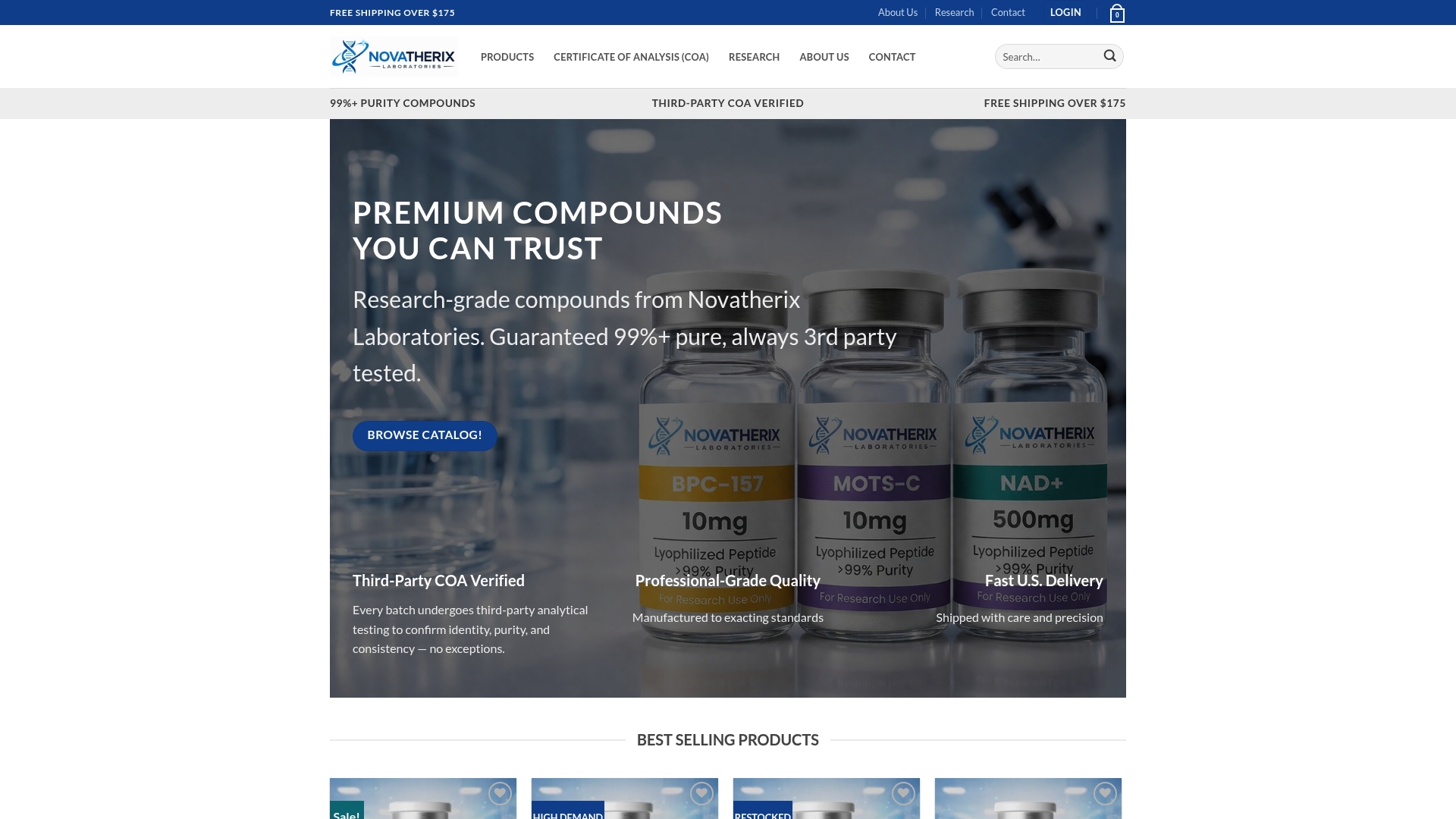
Novatherix ships across the U.S. with fast turnaround, and every compound in the catalog carries the documentation your experiments require. Whether you are sourcing peptides for cellular research or metabolic studies, the full compound catalog gives you verified materials with the traceability records to support reproducible science. Explore the catalog and download COAs directly from each product page.
FAQ
What is verified compound transparency?
Verified compound transparency is the practice of providing batch-specific analytical documentation, including identity, potency, purity, sterility, and endotoxin results, for each production lot of a research compound. It allows researchers to confirm material quality before use.
How does compound transparency work in practice?
A supplier assigns a unique lot number to each batch, sends it to a third-party laboratory for testing, and publishes the resulting COA linked to that specific lot. Researchers match the lot number on the vial label to the COA to confirm the document applies to their material.
Why are unverified compounds risky for research?
Independent testing has documented impurity levels as high as 86% in unverified injectable preparations. Using such materials introduces unknown variables that invalidate experimental results and compromise data integrity.
What should a valid COA include?
A valid COA includes the active ingredient identity, potency percentage, purity result, sterility status, endotoxin levels, residual solvent data, the lot number, and the test date. Any COA missing the lot number cannot be matched to a specific batch and should not be accepted.
What is MSG Trace and how does it help researchers?
MSG Trace is an industry-wide transparency platform launched by Metabolic Supply Group that provides public access to lot-specific COAs and lab results for compounded materials. Researchers can independently verify quality, potency, and sourcing information without relying solely on supplier-provided documents.
Recommended
- Novatherix Laboratories | Research Peptides, COAs, Third Party Testing & Fast Shipping
- Research – Novatherix Laboratories
