
Subcutaneous (SC) delivery is defined as the injection of a compound into the tissue layer just beneath the skin, where it absorbs gradually into systemic circulation. Intravenous (IV) delivery bypasses that tissue entirely, placing the compound directly into the bloodstream for immediate effect. Understanding why subcutaneous vs intravenous delivery differs matters because the route determines bioavailability, onset time, safety profile, and whether a protocol is practical outside a clinical setting. These are not interchangeable options. Each route has a distinct pharmacokinetic signature that shapes every downstream decision in a research or treatment protocol.
Why subcutaneous vs intravenous delivery differs at the pharmacokinetic level
The most fundamental difference between SC and IV delivery is bioavailability. IV administration achieves 100% bioavailability instantly, making it the pharmacokinetic reference standard for all other routes. Every milligram injected intravenously enters systemic circulation immediately. There is no absorption step, no tissue barrier, and no delay in peak plasma concentration.
SC delivery works differently. The compound deposits into the hypodermis, where it must cross capillary walls and, in some cases, enter the lymphatic system before reaching systemic circulation. SC bioavailability runs 20%–40% lower than IV as a result. That gap has direct consequences for dosing calculations, expected peak levels, and the duration of therapeutic effect.

The table below summarizes the core pharmacokinetic differences between the two routes.
| Parameter | Intravenous (IV) | Subcutaneous (SC) |
|---|---|---|
| Bioavailability | 100% (reference standard) | Typically 60%–80% of IV dose |
| Onset of action | Immediate (seconds to minutes) | Delayed (minutes to hours) |
| Peak plasma concentration | Rapid, high peak | Lower, slower peak |
| Duration of action | Shorter (rapid clearance) | Prolonged (sustained release) |
| Volume per administration | Unlimited (via infusion) | Restricted to approximately 2 mL per site |
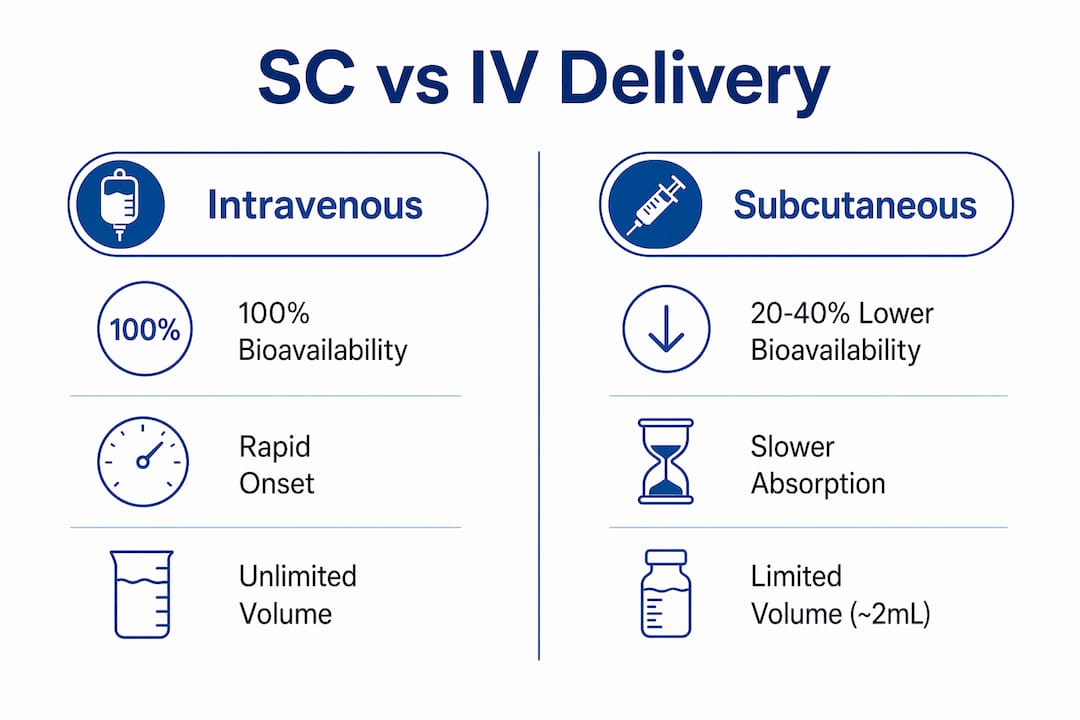
The slower absorption curve of SC delivery is not purely a disadvantage. For compounds where a sustained, lower peak is preferable to a sharp spike, SC administration produces a more favorable concentration-time profile. Researchers studying peptide kinetics, for example, often find that SC dosing more closely mirrors physiological release patterns.
Pro Tip: When interpreting pharmacokinetic data across routes, always compare area under the curve (AUC) values rather than peak concentration alone. AUC captures total drug exposure and gives a more accurate picture of relative bioavailability between SC and IV protocols.
What are the practical advantages and disadvantages of each route?
The operational differences between SC and IV delivery are as significant as the pharmacokinetic ones.
Subcutaneous delivery advantages:
- Administration time drops sharply. SC delivery takes under 10 minutes per session, compared to 30–60 minutes for a standard IV infusion. That reduction in chair time has measurable capacity implications in any setting running multiple sessions per day.
- SC injections support self-administration. Researchers and subjects can manage SC protocols without specialized vascular access equipment, which expands the feasibility of outpatient and home-based study designs.
- SC delivery avoids vascular complications entirely. Phlebitis occurs in up to 31% of IV patients, a risk that SC administration eliminates by bypassing venous access.
- Injection-site reactions with SC delivery are generally mild and localized, resolving without intervention in most cases.
Intravenous delivery disadvantages:
- IV administration is irreversible. Once injected intravenously, a compound cannot be retrieved, which demands strict dose verification and continuous monitoring throughout infusion.
- IV requires trained personnel and sterile vascular access, increasing protocol complexity and cost.
- Repeated IV access causes cumulative vein damage, limiting long-term feasibility in chronic or longitudinal studies.
- Infusion-related reactions, including fever, chills, and hypotension, occur more frequently with IV biologics than with SC equivalents.
The case for SC delivery is strongest in chronic protocols where repeated administration is required. The case for IV delivery is strongest when speed of onset and precise peak concentration are non-negotiable.
What formulation challenges come with switching from IV to SC?
Transitioning a compound from IV to SC delivery is not a simple reformulation. Several technical barriers must be addressed before SC administration becomes viable.
The primary constraint is volume. SC injections are limited to approximately 2 mL per site, which means that any compound requiring a large dose volume for IV delivery must be reformulated at significantly higher concentration for SC use. High-concentration protein formulations introduce their own challenges, including viscosity, aggregation, and stability issues that do not arise at lower concentrations.
The numbered list below outlines the main obstacles and the techniques researchers use to address them.
- Volume restriction. The 2 mL per site limit requires high-concentration formulations. Researchers address this by using multiple simultaneous infusion sites, which can increase total administration volume while staying within per-site limits.
- Viscosity at high concentration. Concentrated protein solutions resist injection. Formulation scientists use excipients such as arginine, histidine, and specific surfactants to reduce viscosity without compromising stability.
- Absorption variability. SC absorption depends on local blood flow, injection site, and tissue composition. Hyaluronidase-enabled formulations address this by temporarily degrading hyaluronic acid in the extracellular matrix, increasing tissue permeability and absorption rate.
- Device compatibility. High-viscosity formulations require specialized autoinjectors or prefilled syringes engineered for higher injection forces. Device selection must be validated alongside the formulation itself.
- Stability under storage conditions. High-concentration SC formulations face greater aggregation risk during storage. Cold-chain requirements and stabilizer selection become more critical than in standard IV formulations.
These challenges are solvable. SC immunotherapies in oncology now demonstrate pharmacokinetic noninferiority to IV routes, which confirms that formulation science has advanced to the point where SC delivery can match IV performance for complex biologics.
When does each delivery route fit the clinical application?
Route selection follows the pharmacology of the compound and the demands of the protocol. The table below maps common research and treatment scenarios to the preferred delivery route.
| Clinical scenario | Preferred route | Rationale |
|---|---|---|
| Emergency dosing requiring immediate effect | IV | 100% bioavailability, seconds-to-minutes onset |
| Chronic biologic administration (weekly or monthly) | SC | Self-administration feasibility, reduced vascular risk |
| Cancer immunotherapy maintenance dosing | SC | Noninferiority to IV confirmed; shorter administration time |
| High-volume fluid or electrolyte replacement | IV | SC volume restriction makes large-volume delivery impractical |
| Peptide research with sustained-release profile | SC | Slower absorption mirrors physiological release patterns |
| Acute pain or sedation requiring rapid titration | IV | Precise, immediate dose control required |
Chronic biologic protocols represent the clearest case for SC adoption. Compounds administered weekly or monthly over years are poor candidates for repeated IV access. SC delivery preserves vascular integrity, reduces administration burden, and in many biologics, produces equivalent systemic exposure.
Acute and emergency scenarios remain firmly in IV territory. When precise peak concentration must be achieved within minutes, the absorption delay of SC delivery is unacceptable. The irreversibility of IV administration is a risk worth taking when speed of action is the primary requirement.
Oncology immunotherapy sits in an interesting middle ground. Recent data shows SC immunotherapy matches IV in pharmacokinetics while reducing infusion-related reactions and cutting session time from 30–60 minutes to under 10 minutes. That combination of equivalent efficacy and better tolerability is shifting protocol design in this area.
Key Takeaways
Subcutaneous and intravenous delivery differ fundamentally in bioavailability, onset speed, volume capacity, and practical feasibility, making route selection a pharmacokinetic and operational decision, not a default one.
| Point | Details |
|---|---|
| Bioavailability gap | SC delivery runs 20%–40% lower bioavailability than IV, requiring adjusted dosing calculations. |
| IV as reference standard | IV achieves 100% bioavailability instantly, making it the benchmark for all pharmacokinetic comparisons. |
| SC time efficiency | SC administration takes under 10 minutes versus 30–60 minutes for IV, with significant capacity benefits. |
| Vascular risk avoidance | SC eliminates phlebitis risk, which affects up to 31% of IV patients, and supports self-administration. |
| Formulation complexity | SC biologics require high-concentration formulations and device validation to overcome the 2 mL volume limit. |
The misconception that held SC delivery back for too long
I have spent years watching researchers default to IV delivery not because the pharmacology demanded it, but because SC was assumed to be the inferior option. That assumption is outdated and, in many cases, costs studies both efficiency and data quality.
The biggest misconception I see is that SC delivery means compromised efficacy. Clinicians and researchers often hold outdated views that SC formulations are less effective or cause significant injection-site pain. Neither holds up against current evidence. Formulation science has closed the bioavailability gap for most biologics, and modern SC devices have made injection-site reactions a minor, manageable issue.
The second misconception is that IV is always safer because it is more controlled. The irreversibility of IV administration is a genuine risk that gets underweighted. A dosing error in an IV protocol cannot be corrected once the compound is in circulation. SC delivery, by contrast, allows for some degree of absorption modulation and carries no vascular complication risk.
My practical advice: evaluate route selection on pharmacokinetic data first, then operational feasibility, then patient or subject experience. Do not let historical defaults drive protocol design. The SC route has earned its place as a primary delivery method for a growing list of compounds, and the research infrastructure to support it, including high-purity formulations and validated devices, is now well established.
— Paul
Novatherix compounds built for rigorous delivery research
Researchers investigating SC and IV pharmacokinetics need compounds they can trust at the formulation level. Purity variability introduces confounding variables that corrupt absorption data and make route comparisons unreliable.
Novatherix Laboratories supplies research-grade peptides verified at 99%+ purity through third-party analytical testing, with certificates of analysis available for every batch. For researchers working on injection-route studies, compounds like ARA-290 and PT-141 are available with full documentation supporting pharmacokinetic protocol design. Fast U.S. delivery and full batch transparency mean your research timeline does not depend on supply uncertainty. When the delivery route is the variable under study, the compound itself cannot be the source of error.
FAQ
What is the main difference between SC and IV delivery?
IV delivery places a compound directly into the bloodstream, achieving 100% bioavailability instantly. SC delivery deposits the compound into subcutaneous tissue, where it absorbs gradually with 20%–40% lower bioavailability than IV.
Can SC delivery match IV delivery in efficacy?
For many biologics, yes. SC immunotherapies in oncology have demonstrated pharmacokinetic noninferiority to IV routes, confirming that formulation advances can close the bioavailability gap for complex compounds.
Why is IV delivery considered irreversible?
Once a compound enters the bloodstream intravenously, it cannot be removed or slowed. This makes precise dosing and continuous monitoring mandatory for IV protocols, particularly with potent or narrow-therapeutic-index compounds.
What limits the volume of SC injections?
SC injections are restricted to approximately 2 mL per site due to tissue capacity constraints. Researchers can use multiple simultaneous infusion sites to increase total volume while staying within per-site limits.
When should researchers choose SC over IV?
SC delivery is preferred for chronic protocols requiring repeated administration, self-administration feasibility, or sustained-release pharmacokinetic profiles. IV remains the choice when immediate onset and precise peak concentration are required.
Recommended
- DSIP – Novatherix Laboratories
- Shipping Information – Novatherix Laboratories
- FL3 Print Package – Novatherix Laboratories
- KPV – Novatherix Laboratories
