
Mass spectrometry verification is defined as the process of confirming that a compendial MS analytical procedure performs with suitable accuracy, specificity, and precision in a specific laboratory environment. The industry standard term is method verification, and it sits one step below full validation in the regulatory hierarchy. Verification confirms that a prescribed procedure meets acceptance criteria outlined in USP General Chapter 1226 before any compound identity or purity data is reported. For researchers and laboratory professionals working with peptides, small molecules, or complex biologics, understanding what mass spectrometry verification means in practice is the difference between reliable data and a compromised result.
What is mass spectrometry verification and how does it differ from validation?
Mass spectrometry verification confirms that an existing, compendial MS method works correctly in your specific lab. Validation, by contrast, demonstrates that a newly developed or alternative method is suitable for its intended use. Validation tests linearity, accuracy, specificity, precision, and robustness when MS methods serve as alternatives to official procedures. Verification applies when you are running a prescribed procedure as written and simply need to confirm it performs as expected in your environment.
The distinction matters because the two processes carry different regulatory burdens. Verification is faster and less resource intensive. It does not require you to establish linearity from scratch. It does require you to demonstrate that your instruments, analysts, and sample matrices do not introduce unacceptable error.

How does mass spectrometry verification work in practice?
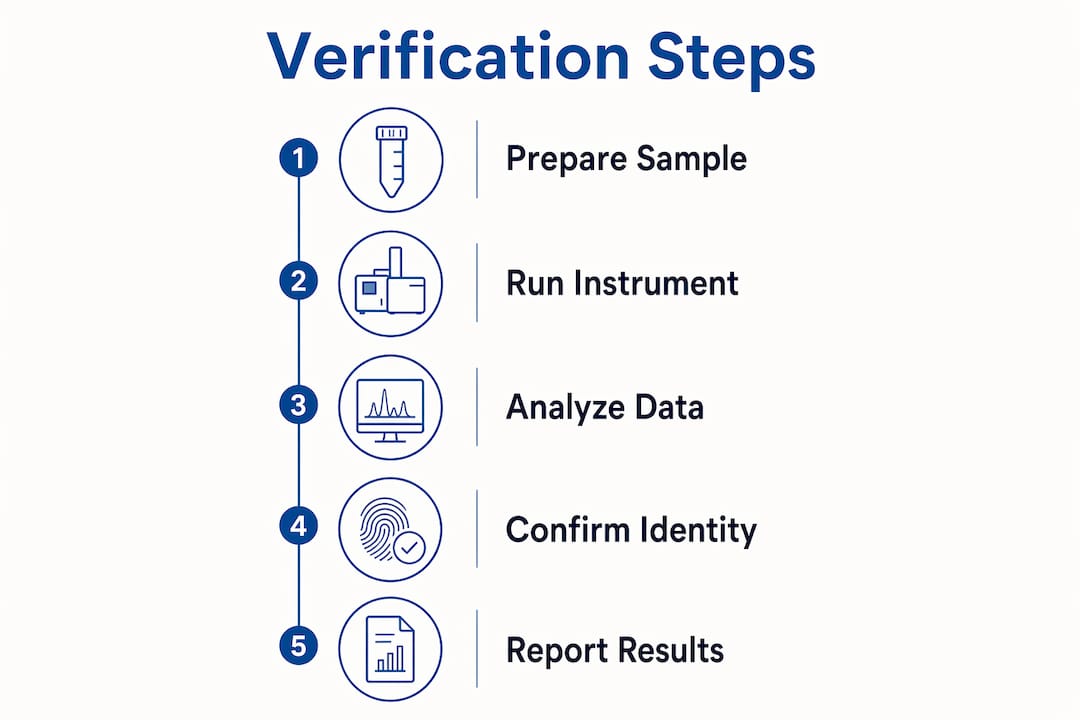
Verification follows a defined sequence of steps, each targeting a specific performance parameter. The goal is to confirm the method behaves in your lab the way it was designed to behave.
- Define the scope. Identify the compound, the matrix, and the regulatory context. A peptide dissolved in acetonitrile behaves differently than the same peptide in a biological buffer.
- Test specificity. Confirm the method distinguishes the target compound from related substances, degradation products, and matrix components. Specificity failures are the most common reason verification does not pass on the first attempt.
- Assess accuracy. Spike known concentrations of the analyte into the matrix and compare measured values to theoretical values. Acceptance criteria per USP Chapter 1226 define the allowable deviation.
- Evaluate precision. Run replicate analyses within a single day (repeatability) and across multiple days or analysts (intermediate precision). Both must fall within defined limits.
- Determine the limit of quantitation (LOQ). Confirm the method can reliably measure the analyte at the lowest concentration required by the test. LOQ is distinct from the limit of detection and carries a stricter signal-to-noise requirement.
- Document and review. Compile all data against the acceptance criteria. If every parameter passes, the method is verified. If one fails, the procedure requires adjustment.
Pro Tip: Run a matrix blank alongside every verification experiment. A blank that shows signal at the target mass immediately flags a contamination or carryover problem before it corrupts your accuracy data.
The role of the analyst matters as much as the instrument. Verification is lab specific and analyst specific. A method verified by one technician on one instrument does not automatically transfer to a second analyst on a different instrument without a bridging experiment.
What are the key mass spectrometry principles relevant to verification?
Mass spectrometry works by ionizing molecules, separating ions by their mass-to-charge ratio (m/z), and detecting them to produce a mass spectrum. The spectrum plots signal intensity against m/z, giving you a fingerprint of every species present and their relative abundance. Three components drive this process: the ion source, the mass analyzer, and the detector. Each affects what you can verify and how reliably you can verify it.
Ionization methods
The ion source determines which compound classes are accessible to the method. Two ionization methods dominate verification workflows:
- Electro spray ionization (ESI): Produces multiply charged ions from solution. ESI is the standard choice for peptides, proteins, and polar small molecules. It couples directly to liquid chromatography, making it the workhorse of pharmaceutical verification labs.
- Matrix-assisted laser desorption/ionization (MALDI): Uses a laser and a co-crystallized matrix to ionize intact macromolecules. MALDI is well suited to high-throughput peptide screening and polymer characterization. MALDI time-of-flight (MALDI TOF) instruments are common in proteomics workflows.
Mass analyzers and their impact on verification
Analyzer choice directly determines resolution, mass accuracy, and the size of molecules you can verify reliably.
| Analyzer | Best for | Resolution | Typical mass range |
|---|---|---|---|
| Quadrupole | Small molecules, unit mass | Unit mass | Under 1,200 amu |
| Time-of-flight (TOF) | Peptides, macromolecules | High | Broad |
| Ion cyclotron resonance / Orbitrap | Large biomolecules, exact mass | Very high | Broad |
Quadrupole analyzers/10%3A_Aggregates_and_Macromolecules/10.01%3A_Mass_Spectrometry) are adequate for small molecules under 1,000–1,200 amu, and macromolecules require high-resolution techniques like TOF or ion cyclotron resonance for accurate verification. Ion cyclotron resonance traps/10%3A_Aggregates_and_Macromolecules/10.01%3A_Mass_Spectrometry) and Orbitraps measure ion oscillation frequency over extended time periods, achieving mass resolution fine enough to resolve mass differences as small as 1 amu in 50,000. That level of resolution is not optional when verifying a 5,000 Da peptide with a single amino acid substitution.
What challenges and nuances should researchers consider in MS verification?
Verification fails more often than most labs anticipate on the first run. Understanding why helps you design experiments that pass the first time.
- Matrix effects. Endogenous compounds in a biological or formulation matrix can suppress or enhance ionization of the target analyte. Suppression shifts your measured concentration below the true value, causing accuracy failures. Ion suppression is particularly severe in ESI-based methods.
- Sequence isomerism. Mass spectrometry identifies compounds by molecular weight. Two peptides with the same amino acid composition but different sequences produce identical molecular weights. MS alone cannot distinguish them. Orthogonal techniques such as nuclear magnetic resonance (NMR) or tandem MS fragmentation are required to resolve sequence isomers.
- Instrument limitations. A quadrupole instrument cannot verify a 10,000 Da peptide with the mass accuracy a TOF instrument provides. Choosing the wrong analyzer for the compound class is a structural problem, not a calibration problem.
- Carryover between injections. High-concentration samples can contaminate subsequent injections, inflating apparent concentrations in low-level samples and causing precision failures.
- Analyst-to-analyst variability. Sample preparation steps such as dilution, reconstitution, and derivatization introduce variability. Intermediate precision testing must include multiple analysts to capture this source of error.
If a prescribed MS procedure fails verification, users must modify or develop alternative methods to maintain regulatory compliance and test suitability. Adjustment is not a failure of the lab. It is the system working as designed.
Pro Tip: When matrix effects cause accuracy failures, evaluate a stable isotope-labeled internal standard. It co-elutes with your analyte, experiences the same ionization suppression, and corrects for it mathematically without changing the method fundamentally.
How is mass spectrometry verification applied in compound purity and identity confirmation?
The practical applications of MS verification span peptide research, small molecule quality control, and counterfeit compound detection. Each use case draws on the same core principles but emphasizes different performance parameters.
Peptide identity confirmation
Mass spectrometry identifies peptides by measuring molecular weight to within instrument precision, confirming compound identity beyond what purity measurement alone can provide. A certificate of analysis (COA) that reports 99%+ purity by HPLC tells you the dominant peak is clean. MS verification tells you the dominant peak is actually the compound you ordered. Both data points are necessary. Neither is sufficient alone. Reviewing a compound purity certificate alongside MS data gives researchers the full picture of what they are working with.
Counterfeit pharmaceutical detection
MS combined with chromatography and NMR forms a reliable approach to characterize counterfeit pharmaceuticals rapidly, enabling accurate molecular weight assignment and formula determination. Low-resolution LC-UV-MS rapidly assesses component weights, while high-resolution MS measures accurate masses to narrow formula candidates. This workflow has been applied to identify substituted active ingredients in counterfeit tablets where visual inspection and basic chromatography were insufficient.
Integration with orthogonal techniques
No single analytical method covers every verification requirement. The standard workflow in a rigorous lab combines:
- HPLC or UHPLC for purity profiling and quantitation of related substances.
- MS for molecular weight confirmation and identity verification.
- NMR for structural confirmation, particularly when sequence isomers or stereoisomers are possible.
- Elemental analysis or Karl Fischer titration for residual solvent and water content.
| Technique | Primary output | Verification role |
|---|---|---|
| HPLC | Purity percentage | Quantitative impurity profiling |
| MS | Molecular weight, m/z spectrum | Identity confirmation |
| NMR | Structural connectivity | Sequence and stereochemistry |
This layered approach is the standard for research-grade compounds where a single analytical failure can invalidate an entire study.
Key takeaways
Mass spectrometry verification confirms that a prescribed MS procedure meets defined accuracy, specificity, and precision criteria in a specific laboratory before compound identity or purity data is reported.
| Point | Details |
|---|---|
| Verification vs. validation | Verification confirms an existing method works in your lab; validation establishes a new method from scratch. |
| Core parameters tested | Specificity, accuracy, precision, and LOQ must all meet USP Chapter 1226 acceptance criteria. |
| Analyzer selection matters | Quadrupoles suit small molecules under 1,200 amu; TOF and Orbitrap instruments are required for macromolecules. |
| Orthogonal methods are necessary | MS alone cannot resolve sequence isomers; NMR or tandem MS fragmentation is required for full structural confirmation. |
| Failed verification requires action | A method that fails verification must be adjusted or replaced before any compound data is considered reliable. |
Why I think most labs underestimate the analyzer selection problem
Researchers often treat instrument choice as a procurement decision made once and revisited rarely. My experience says that is the single biggest source of avoidable verification failures in peptide research labs. A lab that invested in a triple quadrupole for small molecule work will eventually receive a 6,000 Da peptide and attempt to verify it on the same instrument. The mass accuracy simply is not there. The result looks plausible, and that is the danger. A result that looks plausible but is wrong is more damaging than an obvious failure.
The second thing I have seen consistently underestimated is the matrix effect problem in ESI-based methods. Labs run verification in clean solvent, pass every parameter, and then deploy the method on real samples in complex matrices. The method fails in practice because it was never tested in the actual matrix. Verification in clean solvent is not verification of your method. It is verification of your instrument.
The fix is straightforward: run your verification experiments in the matrix you will actually use. If that matrix is not available during method development, flag it explicitly in your verification report and plan a bridging experiment before the method goes live. Regulatory reviewers notice when matrix effects are not addressed, and so do the data.
— Paul
Novatherix compounds come with verified purity documentation
Researchers who need compounds with documented MS verification data do not have to build that workflow from scratch. Novatherix Laboratories supplies research-grade peptides with third-party analytical testing and 99%+ purity verification included with every order.
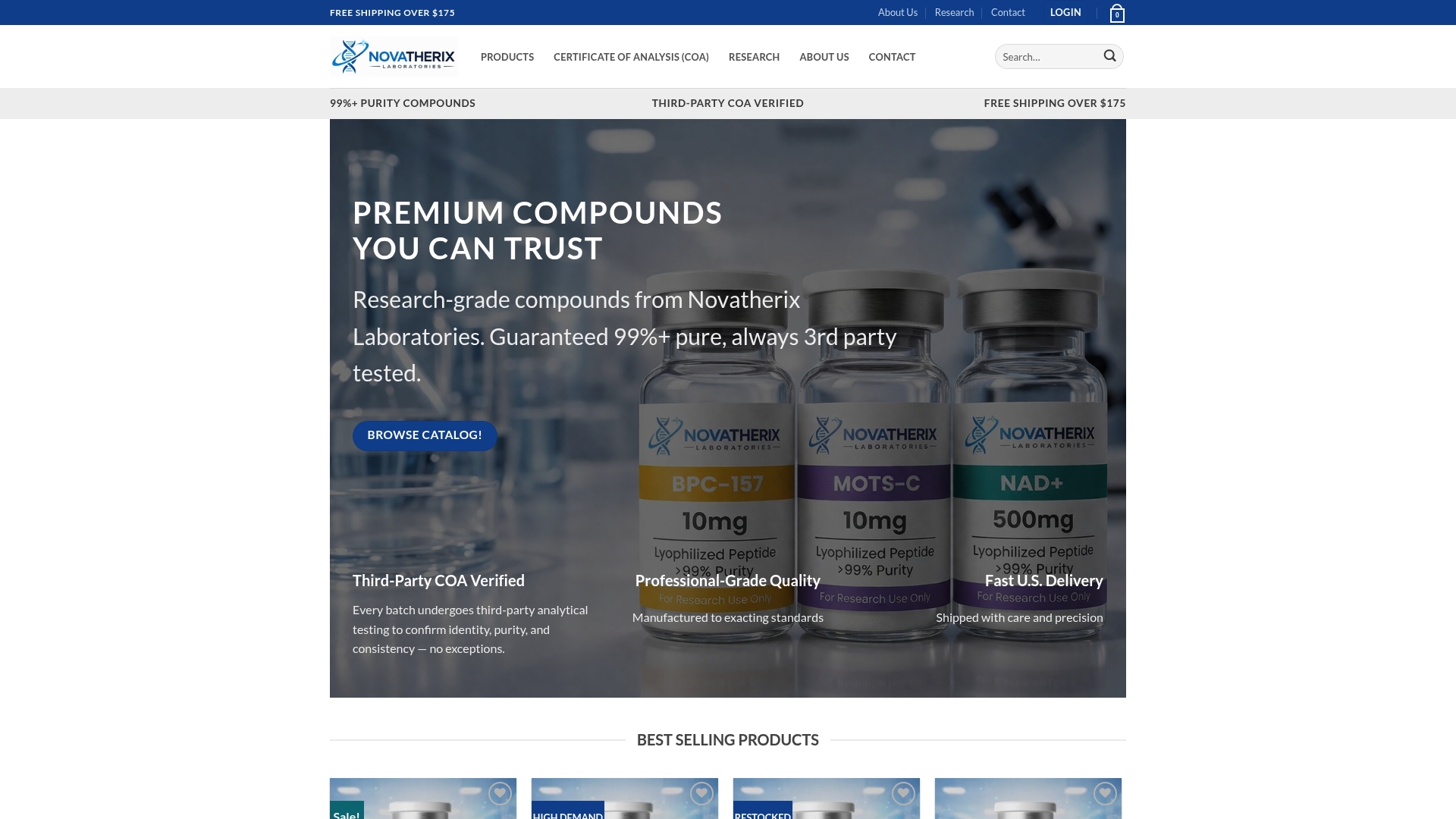
Every compound ships with a certificate of analysis covering MS-confirmed identity and HPLC purity data. Researchers can review COA documentation before ordering to confirm the analytical methods used and the acceptance criteria applied. Fast U.S. delivery and full product transparency mean your verification workflow starts with a compound you can trust, not one you have to qualify from the ground up.
FAQ
What is mass spectrometry verification in simple terms?
Mass spectrometry verification confirms that a prescribed MS analytical procedure performs with acceptable accuracy, specificity, and precision in a specific laboratory. It follows the criteria set out in USP General Chapter 1226.
How does MS verification differ from MS validation?
Verification applies to existing compendial procedures and confirms they work in your lab. Validation applies to newly developed or alternative methods and requires a broader set of performance tests including linearity and robustness.
Can mass spectrometry verify compound purity on its own?
MS confirms compound identity by molecular weight but does not quantify all impurities the way HPLC does. A complete purity assessment requires both MS for identity and chromatography for quantitative impurity profiling.
What happens when a verification experiment fails?
A failed verification means the prescribed procedure is not suitable for the compound under test in that laboratory. The lab must adjust the method or develop an alternative before reporting any compound data.
Which mass analyzer is best for peptide verification?
TOF and Orbitrap instruments are the standard choice for peptides above 1,200 amu because they provide the mass accuracy needed to confirm molecular weight unambiguously. Quadrupole instruments are adequate only for small molecules within their mass range.
Recommended
- Novatherix Laboratories | Research Peptides, COAs, Third Party Testing & Fast Shipping
- MOTS-C – Novatherix Laboratories
- Research Preparation & Reconstitution Guide – Novatherix Laboratories
