
Excipient compatibility testing is the critical preformulation process that screens drug–excipient combinations for interactions capable of causing API degradation, potency loss, or formulation failure. Known formally as excipient compatibility assessment, this discipline sits at the foundation of every solid and liquid dosage form development program. Incompatible excipients trigger chemical degradation, generate toxic byproducts, and compromise bioavailability before a formulation ever reaches a stability chamber. Analytical tools including DSC, FTIR, and HPLC are the standard detection methods, and AI-driven platforms like PharmDE and FormulationDE are now entering early-stage screening workflows. Getting this step right protects every downstream investment in development, manufacturing, and regulatory submission.
What is the role of excipient compatibility testing in formulation development?
The role of excipient compatibility testing is to eliminate unsafe excipient candidates before scale-up, reducing both risk and cost at the earliest possible stage. Incompatibility mechanisms include hydrolysis, oxidation, acid-base reactions, and Maillard reactions, each capable of degrading an API through a distinct chemical pathway. Catching these interactions in preformulation screening prevents reformulation cycles that consume months of development time and significant budget. The importance of excipients in drug formulation extends beyond inert filler status. Excipients directly influence drug release rate, physical stability, and chemical integrity throughout a product’s shelf life.
Excipients in drug formulation serve functional roles: binders hold tablets together, disintegrants control dissolution, and antioxidants protect oxidation-sensitive APIs. Each functional category introduces its own chemical reactivity profile. A lactose-based filler, for example, carries free reducing sugars that react with primary amine APIs through the Maillard pathway, producing brown discoloration and degradation products. Compatibility studies for formulations must account for these functional reactivities, not just molecular weight or solubility parameters.

What are the main chemical and physical mechanisms causing excipient-API incompatibility?
Four primary chemical mechanisms drive most drug-excipient incompatibilities encountered in solid dosage form development.
- Hydrolysis: Water present in excipients like microcrystalline cellulose or magnesium stearate cleaves ester, amide, or lactam bonds in moisture-sensitive APIs. The result is potency loss and the formation of hydrolytic degradants.
- Oxidation: Peroxide impurities in polyethylene glycols and polysorbates oxidize APIs containing sulfide, thioether, or phenol groups. Trace metal contaminants in excipients catalyze this pathway even at low concentrations.
- Maillard reaction: Reducing sugars in lactose and some starches condense with primary or secondary amine groups on APIs. This produces colored Amadori products and reduces assay values over time.
- Acid-base reactions: Excipients with extreme pH microenvironments, such as magnesium stearate (basic) or citric acid (acidic), alter the local ionization state of pH-sensitive APIs, accelerating degradation or changing solubility profiles.
Physical interactions also compromise stability without any covalent bond formation. Adsorption of an API onto excipient surfaces reduces the free drug concentration available for dissolution. Polymorphic conversion driven by excipient moisture or plasticizing effects changes crystal form and alters bioavailability. These physical pathways are harder to detect by chemical assay alone, which is why orthogonal analytical methods are mandatory in any thorough testing program.
Pro Tip: When an API contains both an amine group and a carbonyl, screen lactose and other reducing sugars first. Maillard products form rapidly under accelerated conditions and are often the first incompatibility signal you will see in DSC thermograms.
Which analytical techniques are standard for testing excipient interactions?
The standard experimental workflow for excipient compatibility assessment combines thermal, spectroscopic, and chromatographic methods in a defined sequence. Each method answers a different question about the drug-excipient pair.
-
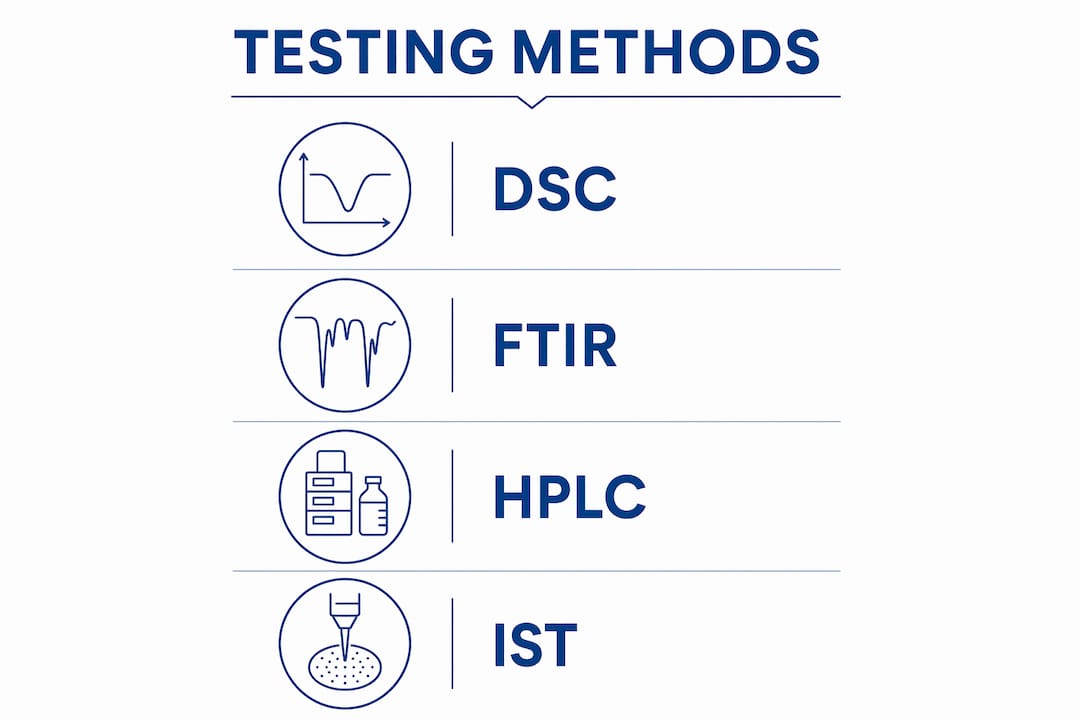
Differential scanning calorimetry (DSC): DSC measures heat flow as a function of temperature. A shift, broadening, or disappearance of an API melting endotherm in a binary mixture signals a thermal interaction. DSC and FTIR serve as rapid screening tools that flag mechanism signals before committing to longer stability studies.
-
Fourier transform infrared spectroscopy (FTIR): FTIR identifies changes in functional group chemistry by comparing the spectrum of a binary mixture against pure API and pure excipient spectra. A band shift or new absorption peak confirms a chemical interaction at the molecular level.
-
High-performance liquid chromatography (HPLC): HPLC quantifies degradation products with specificity and sensitivity that thermal or spectroscopic methods cannot match. HPLC-confirmed degradation is the definitive criterion for classifying an excipient as incompatible. DSC and FTIR generate hypotheses; HPLC confirms them.
-
Isothermal stress testing (IST): IST accelerates chemical and physical interactions by exposing binary mixtures to elevated temperature and humidity. Typical IST conditions use 1:1 binary mixtures at 50°C with 10% water for three weeks, followed by HPLC, FTIR, and DSC analysis to quantify and characterize any degradation statistically.
The table below summarizes how each method contributes to the compatibility decision.
| Method | Primary output | Role in decision |
|---|---|---|
| DSC | Thermal event shifts | Preliminary screening flag |
| FTIR | Functional group changes | Mechanism identification |
| HPLC | Degradation product quantification | Final incompatibility classification |
| IST | Accelerated interaction data | Confirms real-world risk under stress |
Pro Tip: Design your IST sample preparation to match your HPLC protocol from the start. Samples prepared for chromatographic injection without additional processing steps reduce variability and give you cleaner quantification data.
Aligning stress test conditions with your analytical detection methods increases confidence in the final compatibility classification. Orthogonal use of DSC and FTIR provides mechanistic context, while HPLC delivers the objective numerical evidence that regulatory reviewers expect.
How do in-silico tools support excipient compatibility assessment?
AI-driven platforms like PharmDE and FormulationDE now offer early-stage risk ranking of drug-excipient pairs before any wet-lab work begins. In silico tools are valuable for prioritizing which combinations to test experimentally, reducing the number of binary mixtures that need to enter the IST queue. A hierarchical workflow uses one AI platform for initial screening and a second for confirmation, then routes flagged pairs to mandatory laboratory validation.
The practical strengths of these platforms include speed and breadth. A formulation scientist can screen dozens of excipient candidates against a new API in hours rather than weeks. The platforms generate risk scores based on structural features, known interaction databases, and physicochemical parameters. This narrows the experimental workload to the highest-risk combinations.
The limitations are equally clear. In silico predictions are risk assessments and hypotheses, not final answers. They cannot account for excipient-specific impurity profiles, batch-to-batch variability, or physical interactions driven by particle morphology. No regulatory agency accepts computational predictions as a substitute for experimental compatibility data.
- Use discrepancies between two AI models as a triage signal. When PharmDE and FormulationDE disagree on a pair, that excipient moves to the top of the wet-lab priority list.
- Do not eliminate excipients based on in silico scores alone. A low-risk prediction still requires at least a DSC screen before the excipient is cleared for formulation use.
- Treat computational tools as a resource allocation decision, not a compatibility decision.
Researchers working with peptide-based APIs, such as those studying GLP-1 analogs or other complex molecules, face particularly high incompatibility risk due to the reactivity of amine and thiol groups. In silico screening is especially useful for these compound classes because it narrows the experimental burden before committing scarce API material to binary mixture studies.
What is the regulatory significance of compatibility studies for formulations?
Compatibility data is a regulatory requirement, not an optional quality exercise. ICH Q8 includes excipient compatibility assessments as formal documentation within the pharmaceutical development section of a submission. Sponsors must justify each excipient choice with data demonstrating that the component does not compromise API integrity under intended manufacturing and storage conditions.
The ICH Q1 stability framework connects directly to compatibility outcomes. Compatibility studies inform moisture-driven degradation risks and determine which critical quality attributes require monitoring in the formal stability program. If compatibility testing reveals that an API degrades via hydrolysis in the presence of a specific binder, moisture content becomes a critical quality attribute that must be controlled and monitored throughout shelf life.
Quality by Design (QbD) frameworks require formulation scientists to understand and document the design space of their product. Compatibility data defines the boundaries of that space by identifying which excipients introduce unacceptable degradation risk. Regulatory reviewers in FDA and EMA submissions expect this data to be presented systematically, with clear analytical methods, stress conditions, and acceptance criteria documented.
The practical implications for shelf life are direct. An excipient that accelerates API degradation by even a modest rate under storage conditions can cut a target 24-month shelf life to 12 months or less. Identifying that excipient in preformulation screening rather than in a 12-month real-time stability study saves years of development time.
Key Takeaways
Excipient compatibility assessment is the preformulation discipline that protects API integrity, defines stability program attributes, and satisfies ICH Q8 regulatory documentation requirements across every dosage form.
| Point | Details |
|---|---|
| Test early to reduce cost | Identifying incompatible excipients before scale-up prevents costly reformulation cycles later in development. |
| Use orthogonal methods | DSC and FTIR flag mechanisms; only HPLC-confirmed degradation data classifies an excipient as incompatible. |
| IST accelerates detection | Binary mixtures at 50°C with 10% water for three weeks reveal interactions not visible at room temperature. |
| In silico tools triage, not decide | AI platforms like PharmDE rank risk and reduce experimental load but require mandatory in vitro validation. |
| Regulatory submissions require data | ICH Q8 mandates documented compatibility assessments to justify excipient selection in pharmaceutical development. |
What I’ve learned from working through borderline compatibility data
The hardest part of excipient compatibility work is not the clear failures. A DSC thermogram showing complete melting point suppression and an HPLC chromatogram full of new peaks makes the decision easy. The genuinely difficult cases are the borderline ones, where DSC shows a subtle shoulder and HPLC detects a degradant at 0.1% after three weeks of IST. Those cases demand judgment, and that judgment has to be grounded in mechanism, not just numbers.
My experience is that formulation scientists underuse FTIR as a mechanistic tool. They run it as a checkbox after DSC, note the spectrum looks “similar,” and move on. A careful overlay of the binary mixture spectrum against the pure components, with attention to carbonyl stretching frequencies and N-H bending regions, often reveals the chemistry behind a borderline DSC result. That mechanistic understanding changes how you interpret the HPLC data and whether you classify the excipient as a conditional pass or a firm reject.
The other pattern I see repeatedly is overconfidence in in silico outputs. PharmDE and FormulationDE are genuinely useful tools. But when a computational platform gives a low-risk score for a lactose-amine pair, and your DSC shows a clear Maillard signal, trust the bench. The model does not know your specific excipient batch’s reducing sugar content. The bench does.
The future of this field sits in tighter integration between computational screening and automated IST platforms. Faster data generation means more combinations tested per development cycle. The scientists who will do this work best are those who understand the chemistry well enough to know when the data is telling the truth and when it is an artifact.
— Paul
Novatherix Laboratories: research-grade compounds for formulation scientists
Pharmaceutical researchers need compounds they can trust before any compatibility study begins. Novatherix provides research-grade compounds verified at 99%+ purity through rigorous third-party analytical testing, giving formulation scientists a reliable starting point for binary mixture studies and stability assessments.
Every compound from Novatherix ships with full analytical documentation, including certificates of analysis that support regulatory traceability. Fast U.S. delivery and transparent purity reporting mean you spend less time validating your starting material and more time generating compatibility data that matters. For researchers working with peptide APIs or complex molecules, Novatherix’s verified purity certificates provide the documentation foundation your formulation program requires.
FAQ
What is excipient compatibility testing?
Excipient compatibility testing is a preformulation screening process that evaluates drug-excipient binary mixtures for chemical and physical interactions that could degrade the API, reduce potency, or cause formulation failure.
Which analytical methods detect drug-excipient incompatibilities?
DSC, FTIR, and HPLC are the standard methods. DSC and FTIR provide rapid mechanism signals, while HPLC-confirmed degradation data is the definitive criterion for classifying an excipient as incompatible.
What is isothermal stress testing in excipient compatibility studies?
Isothermal stress testing exposes binary drug-excipient mixtures to elevated temperature and humidity, typically 50°C with 10% water for three weeks, to accelerate and detect interactions that would not appear under ambient storage conditions.
How do in-silico tools fit into compatibility assessment workflows?
AI platforms like PharmDE and FormulationDE rank excipient risk and reduce the number of combinations requiring wet-lab testing, but in silico predictions require mandatory in vitro validation before any formulation decision is finalized.
Why do regulatory agencies require compatibility data?
ICH Q8 mandates documented excipient compatibility assessments to justify component selection in pharmaceutical development submissions. Compatibility data also informs the critical quality attributes monitored in ICH Q1 stability programs.
Recommended
- Semax – Novatherix Laboratories
- KissPeptin-10 – Novatherix Laboratories
- Research Preparation & Reconstitution Guide – Novatherix Laboratories
- Novatherix Laboratories | Research Peptides, COAs, Third Party Testing & Fast Shipping
