
Third-party testing is defined as independent laboratory evaluation of a product’s safety, composition, and performance by an organization with no financial stake in the outcome. The role of third-party testing in safety goes far beyond checking a box. It shifts product claims from “trust us” to verifiable evidence, and that shift carries legal, commercial, and scientific weight. The third-party testing market was valued at approximately $50 billion in 2025 and is projected to reach $85 billion by 2033. That growth reflects a global recognition that internal testing alone cannot satisfy regulators, researchers, or safety-conscious consumers.
How does third-party testing enhance safety beyond internal testing?
Third-party testing provides unbiased assessments that product claims are accurate and meet quality or safety standards. Internal testing, by contrast, is conducted by the manufacturer, which creates an inherent conflict of interest. A company that funds its own safety evaluation has financial incentive to reach favorable conclusions.
The practical consequences of that conflict are significant. Internal labs may use testing methods calibrated to confirm expected results rather than detect anomalies. Third-party labs select methods based on scientific rigor, not commercial preference. That difference in methodology is where safety failures get caught or missed.

Independent testing also catches problems early enough to prevent costly recalls. When a defect surfaces in a third-party audit before a product ships, the manufacturer can correct it without public exposure. When it surfaces after a recall, the costs multiply across logistics, legal fees, and brand damage.
Key advantages of independent testing over internal evaluation:
- No conflict of interest. The lab has no stake in the result, which removes pressure to overlook marginal findings.
- Regulatory evidentiary value. Courts and regulators treat third-party data as credible evidence. Internal data is treated with skepticism.
- Broader methodology. Independent labs apply the full range of applicable standards, not just the ones a manufacturer selects.
- Early defect detection. Problems identified before market entry cost a fraction of post-launch corrections.
- Supplier accountability. Third-party results give procurement teams objective grounds to reject or renegotiate with underperforming suppliers.
Pro Tip: Request that your independent lab specify which analytical method it used for each test. The distinction between broad screening techniques and targeted analytical methods directly affects result accuracy and your risk profile.
What regulatory frameworks and market trends are driving third-party testing?
Regulatory pressure is the single largest driver of third-party testing adoption across industries. Frameworks like MoCRA (the Modernization of Cosmetics Regulation Act) now require safety substantiation records supported by independent lab data. Brands that cannot produce that documentation face FDA adulteration claims and mandatory recalls.
OSHA’s Nationally Recognized Testing Laboratories (NRTL) program requires that electrical products sold in U.S. workplaces carry certification from an accredited independent lab. Uncertified electrical products are linked to 12–13% of structure fires and nearly 2% of fatal workplace injuries in the U.S. Those numbers make the case for mandatory independent certification more clearly than any policy argument.
Consumer skepticism is accelerating the trend beyond regulatory minimums. Researchers and safety-conscious consumers now routinely request Certificates of Analysis before purchasing compounds, supplements, or research materials. Brands that cannot produce independent documentation lose credibility regardless of their internal quality claims.
“Brands that make third-party testing proof readily available to consumers gain commercial advantage through enhanced trust, while hidden evidence diminishes value.” — Defacto Labs
The sectors most affected by third-party testing requirements span a wide range:
| Sector | Primary standard or framework | Key risk addressed |
|---|---|---|
| Electrical products | OSHA NRTL program | Fire and workplace injury |
| Cosmetics and personal care | MoCRA (FDA) | Adulteration and contamination |
| Dietary supplements | NSF, USP, ISO 17025 labs | Label accuracy and purity |
| Children’s products | CPSC regulations | Chemical and physical hazards |
| Research compounds | ISO 17025 accredited labs | Purity and identity verification |
Each sector faces distinct failure modes. The common thread is that independent verification catches what internal processes miss.
How does the third-party testing process work?
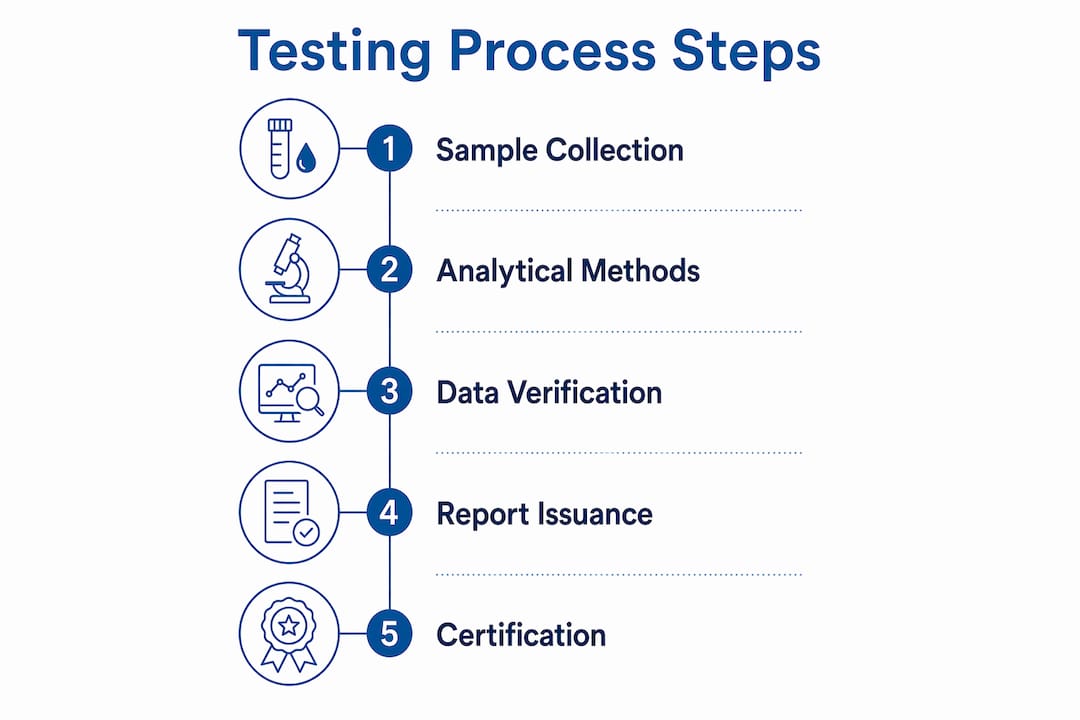
Third-party testing follows a defined sequence that separates it from both internal quality checks and GMP audits. Understanding each step helps researchers and procurement teams interpret results correctly.
The process begins with sample collection. An accredited lab receives a product sample, either submitted by the manufacturer or collected independently to prevent tampering. Independent collection is the gold standard because it eliminates the possibility that a manufacturer submitted a specially prepared batch.
The lab then applies analytical methods appropriate to the product category. For research compounds, this typically includes high-performance liquid chromatography (HPLC) for purity verification, mass spectrometry for identity confirmation, and microbial testing for contamination. The lab documents every method used, which allows results to be audited and replicated.
Certificates of Analysis and what they actually tell you
A Certificate of Analysis (CoA) is the formal output of third-party testing. It lists the tested parameters, the methods used, the results, and the lab’s accreditation status. A CoA from an ISO 17025 accredited lab carries significantly more weight than one from an unaccredited facility. ISO 17025 is the international standard for testing and calibration laboratory competence. It requires documented procedures, proficiency testing, and regular external audits.
Good Manufacturing Practice (GMP) certification covers manufacturing processes, whereas third-party testing analyzes actual product batches for safety and content verification. The two are complementary but not interchangeable. A facility can hold GMP certification and still produce a batch that fails purity testing.
| Assessment type | What it evaluates | Output document |
|---|---|---|
| Third-party product testing | Actual batch composition and safety | Certificate of Analysis (CoA) |
| GMP audit | Manufacturing process and facility controls | GMP certification |
| ISO 17025 accreditation | Lab competence and method validity | Accreditation certificate |
Pro Tip: When reviewing a CoA, check the accreditation number of the issuing lab against the relevant national accreditation body’s public database. A CoA without a verifiable accreditation number is not independent verification.
Procurement teams that rely solely on supplier-provided CoAs expose themselves to “quality fade,” a gradual decline in raw material quality that suppliers may not disclose. Randomized third-party baseline testing detects that drift before it reaches end users.
What are the legal and commercial impacts of third-party safety evaluations?
Independent testing data carries direct legal weight in product liability cases. Independent labs provide forensic analysis for product failures, enabling manufacturers and legal teams to pinpoint contamination sources and shift liability appropriately. A manufacturer with documented baseline testing can demonstrate that a contamination event occurred after the product left its facility.
The benefit-of-the-bargain legal theory allows claims for economic injury from unsupported safety claims even without physical harm. A consumer who paid a premium for a product marketed as “99% pure” can sue for the price difference if independent testing reveals lower purity. That legal exposure exists whether or not anyone was physically harmed.
Commercial benefits of third-party certification extend well beyond litigation defense:
- Certification marks build purchase confidence. Certification marks from accredited labs serve as trusted signals to buyers that products meet stringent safety standards beyond manufacturer claims.
- Recall prevention protects revenue. Early detection of defects through independent testing avoids the full cost of a public recall, which includes logistics, legal fees, and lost future sales.
- Regulatory compliance reduces enforcement risk. Brands with documented independent testing records face fewer FDA inquiries and enforcement actions.
- Transparency drives repeat purchases. Researchers who can verify purity independently return to suppliers who make that verification easy.
How to apply third-party testing insights in research and procurement
Integrating independent testing into supply chain and product development requires a structured approach. These steps reflect current best practice for researchers and procurement professionals:
- Establish baseline testing at supplier qualification. Test raw materials from every new supplier before committing to volume orders. This creates a documented quality benchmark for future comparison.
- Use randomized batch testing for ongoing monitoring. Do not test only the first shipment. Randomized testing across batches catches quality fade that a one-time evaluation misses.
- Select labs accredited to ISO 17025 for your product category. Accreditation requirements vary by product type. A lab accredited for food testing may not be the right choice for research compounds.
- Make CoA documentation accessible to stakeholders. Researchers and procurement teams should be able to retrieve CoAs for any batch without delay. Centralized documentation systems prevent gaps in the record.
- Prepare a response plan for adverse findings. Manufacturers should prepare for preemptive third-party testing by external organizations, having plans in place to respond swiftly and evaluate methodologies. A documented response protocol demonstrates good faith to regulators and courts.
- Align lab selection with analytical method requirements. The choice between broad screening and targeted analytical techniques affects result accuracy. Confirm that the lab’s standard methods match the risk profile of your product.
Key Takeaways
Third-party testing is the most credible form of product safety verification because it removes the conflict of interest that makes internal testing unreliable, and it produces legally defensible documentation that protects both manufacturers and end users.
| Point | Details |
|---|---|
| Independence removes bias | Labs with no financial stake in results produce findings that regulators and courts treat as credible evidence. |
| Regulatory frameworks require it | MoCRA, OSHA NRTL, and CPSC rules make independent testing a legal necessity across multiple product categories. |
| CoAs require accreditation verification | A Certificate of Analysis only carries weight when issued by an ISO 17025 accredited lab with a verifiable accreditation number. |
| Baseline testing prevents quality fade | Randomized third-party testing across supplier batches catches gradual quality decline before it reaches end users. |
| Legal exposure exists without testing | The benefit-of-the-bargain theory creates financial liability for brands with unsupported safety claims, even absent physical harm. |
Why I think third-party testing is now a baseline expectation, not a differentiator
The framing of third-party testing as a competitive advantage made sense a decade ago. It no longer does. Regulatory bodies have closed the gap between “encouraged” and “required” across enough product categories that independent testing is now the floor, not the ceiling.
What I find more interesting is the transparency layer. Testing alone does not build trust. Making the results visible and verifiable does. Brands that publish CoAs with verifiable accreditation numbers, batch numbers, and method disclosures are doing something genuinely different from brands that simply claim to test. The former invites scrutiny. The latter avoids it.
The emerging challenge is methodological depth. As products grow more complex, broad screening methods miss what targeted analytical techniques catch. Deep, secure audits beyond superficial checks are the direction the field is moving, and brands that invest in that depth now will be better positioned when regulators formalize the requirement. The gap between a CoA that lists one purity figure and a full analytical report with method validation is where the next wave of product liability cases will be decided.
— Paul
Novatherix Laboratories and verified research-grade compounds
Researchers who require compounds with documented purity need more than a manufacturer’s assurance. Novatherix Laboratories subjects every compound to rigorous independent analytical testing, producing verified Certificates of Analysis that confirm 99%+ purity through accredited third-party labs.
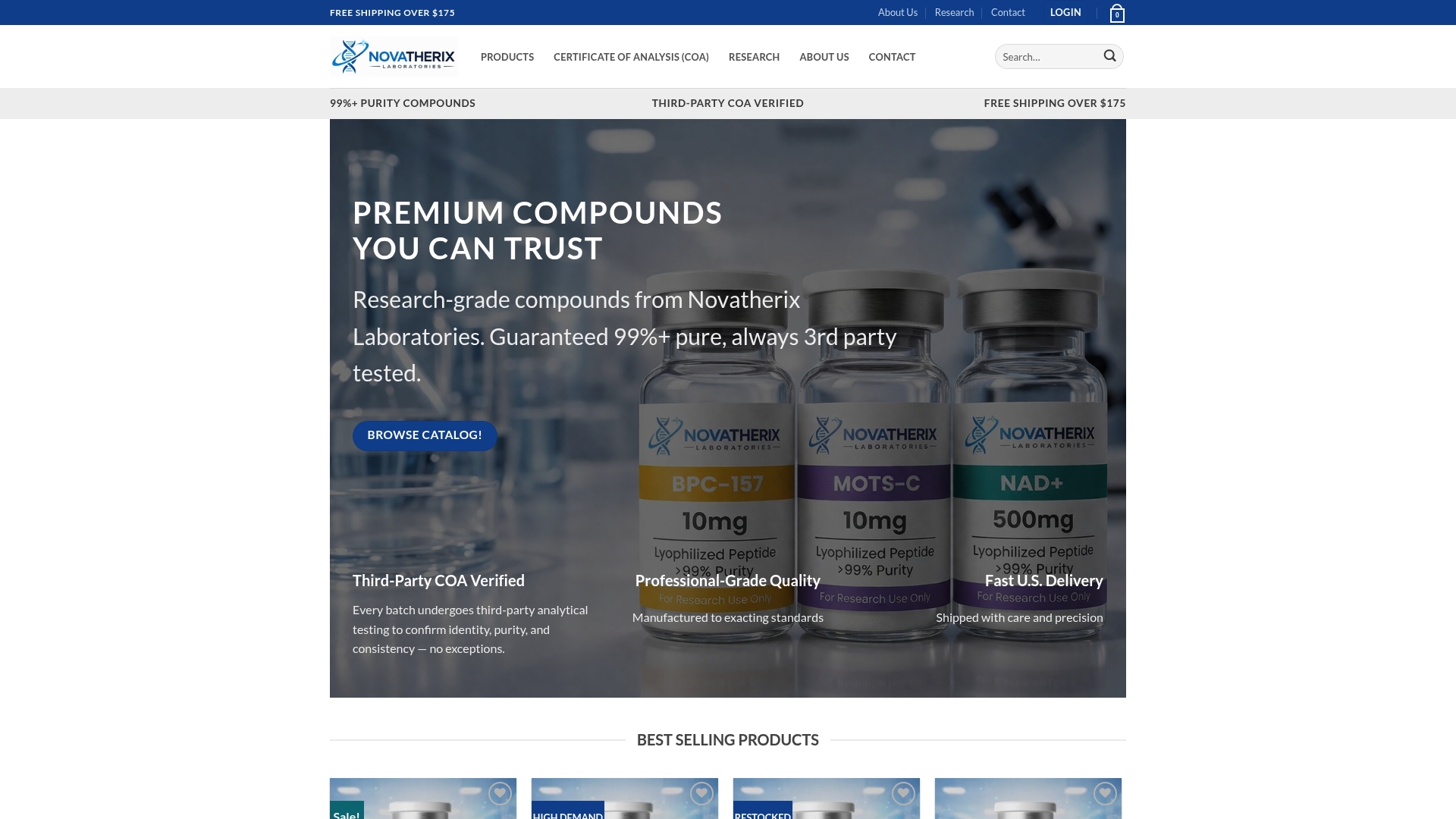
Every batch in the Novatherix research collections ships with full CoA documentation, giving researchers the independent verification they need before beginning any protocol. Fast U.S. delivery and transparent reporting make Novatherix a practical choice for professionals who cannot afford uncertainty in their source materials. Visit Novatherix Laboratories to review available compounds, CoAs, and current inventory.
FAQ
What is the role of third-party testing in safety?
Third-party testing provides independent, unbiased verification that a product meets safety and quality standards. It removes the conflict of interest inherent in internal testing and produces legally defensible documentation.
How does third-party testing differ from GMP certification?
GMP certification evaluates manufacturing processes and facility controls, while third-party product testing analyzes actual batch composition and purity. Both are necessary but address different aspects of product safety.
What is a Certificate of Analysis and why does accreditation matter?
A Certificate of Analysis documents the results of third-party testing for a specific product batch. Accreditation to ISO 17025 confirms that the issuing lab meets internationally recognized standards for testing competence and method validity.
What legal risks exist for brands without independent testing?
The benefit-of-the-bargain legal theory allows consumers to claim economic injury from unsupported safety claims even without physical harm. Brands without independent testing documentation face direct financial liability in product litigation.
How often should third-party testing be conducted?
Randomized batch testing across ongoing supplier shipments is the standard practice. A single qualification test is insufficient because it does not detect quality fade that can develop over time in raw materials.
Recommended
- Novatherix Laboratories | Research Peptides, COAs, Third Party Testing & Fast Shipping
- MOTS-C – Novatherix Laboratories
- SS-31 – Novatherix Laboratories
