
Supplement sourcing best practices are the documented procedures and quality checkpoints that guarantee raw materials meet verified purity, identity, and safety standards before they enter any research or formulation workflow. The industry term for this discipline is raw material qualification, governed primarily by FDA 21 CFR Part 111 (Good Manufacturing Practices for dietary supplements), which sets binding requirements for supplier documentation, incoming testing, and approved vendor list maintenance. Researchers and quality-conscious professionals who skip these steps risk working with adulterated, mislabeled, or subpotent ingredients. Sourcing is now a compliance discipline involving traceability from farm to finished product, and that shift has made documentation rigor non-negotiable.
1. What essential criteria qualify a supplement supplier?
Supplier qualification is the first gate in any sound sourcing program. A qualified supplier must provide complete specification sheets, Certificates of Analysis (COAs) from multiple independent lots, current GMP certificates, and evidence of regulatory compliance in their country of origin.
- Specification sheets must define identity, potency, particle size, moisture, and microbiological limits before any purchase order is issued.
- COAs must accompany every shipment and reference the analytical method used. A COA without a method reference is unverifiable.
- GMP certificates must be current. Expired certificates indicate a lapse in audited manufacturing controls.
- Regulatory compliance checks should cover FDA registration status for domestic suppliers and import alert history for foreign ones.
FDA requires annual re-qualification for supplement suppliers, including GMP confirmation and lot performance review. Vendor lists not reviewed in three or more years are active compliance red flags. The approved vendor list (AVL) is not a static document. It requires scheduled review, and any supplier who fails two specification checks within 12 months without a documented corrective action plan should be de-listed immediately.
Pro Tip: Run a short audit checklist before placing any first order: confirm the supplier’s GMP certificate expiration date, request COAs from at least three separate lots, and verify that each COA references a specific analytical method such as HPLC or FTIR.

2. How to verify product quality and purity through documentation
Documentation review and independent laboratory testing are the two pillars of ingredient verification. Neither replaces the other.
“Contract manufacturers vary dramatically in testing depth. Some rely solely on supplier COAs without independent verification. Demanding sample reports and validated COAs is the only way to confirm quality alignment before committing to a supplier.” — Supplement Ingredient Sourcing Strategies
Evaluating a COA requires more than checking that numbers fall within specification. Identical potency results across multiple independent lots indicate likely falsification. Natural analytical variation always exists between production runs, so perfectly uniform values across three or more lots signal that the document was fabricated or copied.
The recommended analytical methods by ingredient type are:
- HPTLC (High-Performance Thin-Layer Chromatography): The gold standard for botanical identity verification against authenticated reference standards. DNA barcoding often fails with processed botanicals, making HPTLC the preferred method per USP chapter <561>.
- FTIR and NMR: Used for identity confirmation of synthetic and semi-synthetic compounds.
- HPLC: The standard method for potency quantification across most supplement categories.
- Microbial screening: Must meet USP <2021> and <2022> standards for total aerobic count and specified organisms.
- Adulterant screening: Particularly relevant for botanical extracts and protein concentrates, where economic adulteration is common.
A risk-based testing program applies 100% lot testing for the first 3–5 shipments from any new supplier. Once a supplier demonstrates consistent performance, skip-lot sampling reduces overhead without sacrificing quality assurance. Novatherix applies this same principle, conducting third-party analytical testing on every compound to confirm 99%+ purity before release. Researchers who need to understand how to read and interpret a certificate of analysis will find that the structure of a legitimate COA follows a predictable format that makes red flags easy to spot once you know what to look for.
3. What strategies manage supplement supply chain risks?
Supply chain risk management starts with knowing exactly where each ingredient originates, not just where it was last shipped from. Country of origin and country of shipment are often different, and conflating them creates a false picture of concentration risk.
China supplies 56.3% of U.S. vitamin imports, with India supplying 6.9%. That concentration means a tariff change, regulatory action, or production disruption in China affects the majority of the U.S. supplement supply chain simultaneously. The effective duty stack on a China-origin ingredient can reach 43% of FOB cost, which directly compresses margins on finished products.
The practical risk management steps are:
- Map ingredient origins by actual country of origin, not shipment origin. Request country-of-origin declarations from every supplier.
- Qualify alternate suppliers in different geographic regions for any ingredient that represents more than 10% of your total raw material spend.
- Prioritize safety stock for high-spend, single-sourced inputs only. Overstocking only 3–5 critical ingredients prevents cash flow problems while protecting against supply disruptions.
- Model landed cost scenarios with and without current tariff rates. This informs pricing decisions and protects margin before a disruption occurs, not after.
| Risk Factor | Mitigation Action | Priority |
|---|---|---|
| Single-country sourcing | Qualify alternate supplier in a second country | High |
| Single-sourced ingredient | Maintain 60–90 days safety stock | High |
| Tariff exposure | Model landed cost with and without tariffs | Medium |
| Supplier performance decline | Trigger re-qualification after first failure | High |
Pro Tip: Public supplement brands carry approximately 78 days of inventory on average. Use that benchmark to calibrate your own safety stock targets for critical ingredients, and avoid exceeding it for lower-risk, multi-sourced inputs.
4. Practical tips for everyday sourcing operations
Effective supplement sourcing requires discipline at the operational level, not just at the policy level. The following practices separate programs that hold up under audit from those that fail at the first deviation.
- Lock specifications before pricing. Agreeing on price before finalizing ingredient specifications creates pressure to accept substandard material later. Specifications must be signed off first.
- Demand documentation upfront. Request full specification sheets, COAs from multiple lots, GMP certificates, and allergen declarations before issuing a purchase order. Suppliers who resist this request are not qualified.
- Build in secondary suppliers. Every critical ingredient should have at least one qualified alternate supplier in a different country. Qualifying a backup supplier takes time. Do it before you need it.
- Implement change notification protocols. Require suppliers to notify you in writing before changing raw material sources, manufacturing sites, or production processes. A supplier who changes their botanical extract source without notice can invalidate months of prior testing data.
- Test incoming shipments systematically. Apply your risk-based testing program consistently. Document every deviation, escalate any out-of-specification result to a formal investigation, and never release material pending investigation.
- Use small-batch orders to validate new suppliers. Low minimum order quantity (MOQ) test orders let you run full incoming testing before committing to large purchase volumes. A supplier who refuses small validation orders is signaling that their quality is volume-dependent.
Traceability and responsibility in sourcing are now operational requirements driven by retailer and consumer demands. Independent certifications for ethical and environmental sourcing strengthen brand trust and reduce audit risk simultaneously. Researchers using the reconstitution and preparation guide from Novatherix will recognize that the same documentation discipline applied to sourcing carries directly into laboratory preparation protocols.
Key takeaways
The most effective approach to supplement sourcing combines rigorous supplier qualification, independent lot testing, and geographic supply chain diversification to protect both quality and business continuity.
| Point | Details |
|---|---|
| Qualify suppliers formally | Require GMP certificates, multi-lot COAs, and specification sheets before any first order. |
| Test COAs for authenticity | Identical potency values across lots signal falsification; natural variation is always present. |
| Apply risk-based testing | Run 100% lot testing for new suppliers, then transition to skip-lot sampling after consistent performance. |
| Diversify supply chain geography | China supplies over 56% of U.S. vitamin imports; qualify alternates in different regions for critical inputs. |
| Review your vendor list annually | FDA expects annual re-qualification; vendor lists older than three years are compliance red flags. |
Why most sourcing programs fail after the first audit
The uncomfortable truth about supplement sourcing is that most programs are built for the initial qualification and then left to drift. Suppliers get qualified once, added to the approved vendor list, and then nobody looks at them again until something goes wrong. That is exactly how adulterated material ends up in finished products.
Ongoing audits are not a bureaucratic formality. They are the mechanism that catches supplier drift before it becomes a recall. A supplier who passed a GMP audit three years ago may have changed their raw material source, their manufacturing site, or their testing laboratory since then. Without a scheduled re-qualification process, you have no way to know.
Transparency and traceability have moved from marketing claims to operational requirements. Retailers and research institutions now demand documentation that traces an ingredient from its country of origin through every processing step to the finished lot. Suppliers who cannot provide that chain of custody are a liability, regardless of how competitive their pricing is.
The risk of relying solely on manufacturer-supplied COAs is real and well-documented. A COA provided by the same party selling the material has an inherent conflict of interest. Independent third-party testing removes that conflict. The cost of independent testing is a fraction of the cost of a product recall or a failed audit. Researchers who treat sourcing as a compliance discipline rather than a purchasing function will find that quality problems become rare rather than routine.
— Paul
Novatherix and the standard for verified research compounds
Researchers who require compounds with documented purity and full analytical transparency do not have to build that verification infrastructure from scratch. Novatherix Laboratories provides research-grade compounds that undergo rigorous third-party analytical testing, with every product released at 99%+ purity.
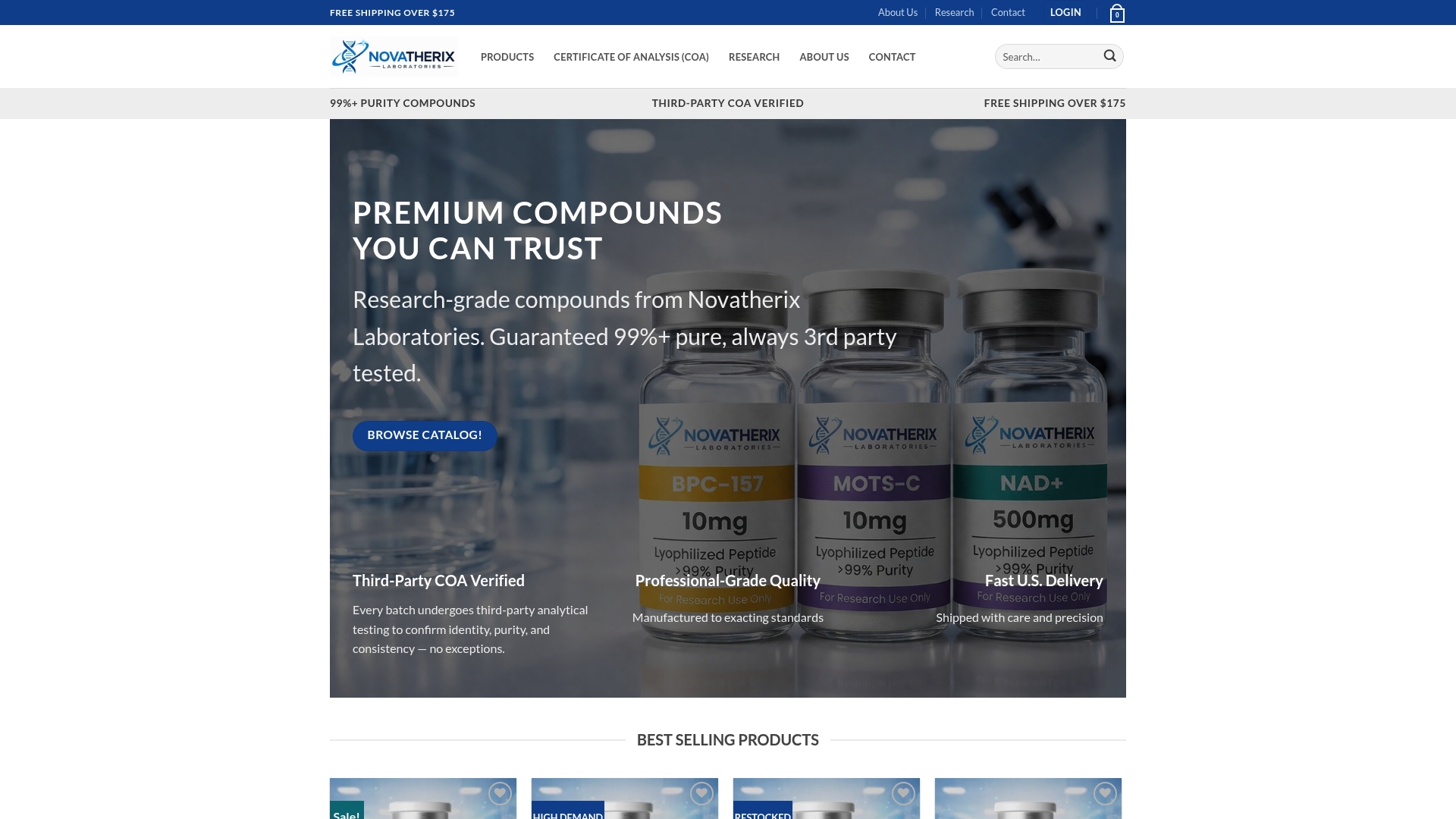
Every order from Novatherix includes verified COAs and independent lab results, giving researchers the documentation foundation that sourcing best practices require. The research collections cover a broad range of compounds for cellular, metabolic, and molecular studies, all backed by the same testing standard. Fast U.S. delivery and full product transparency mean researchers spend less time chasing documentation and more time on the work that matters.
FAQ
What is the FDA standard for supplement supplier qualification?
FDA 21 CFR Part 111 requires that supplement manufacturers qualify raw material suppliers through documentation review, incoming testing, and annual re-qualification. Vendor lists not reviewed in three or more years are considered compliance red flags.
How do you spot a falsified COA?
Identical potency values across multiple independent lots are the clearest indicator of a falsified COA. Legitimate analytical results always show natural variation between production runs.
What is the best testing method for botanical identity?
HPTLC against authenticated reference standards is the gold standard for botanical identity verification. DNA barcoding frequently fails with processed botanical materials and does not meet USP chapter <561> guidance for identity confirmation.
How much safety stock should you carry for critical ingredients?
Public supplement brands carry approximately 78 days of inventory on average. Overstocking should be limited to 3–5 high-spend, single-sourced ingredients to avoid cash flow problems while protecting against supply disruptions.
Why is independent third-party testing better than relying on supplier COAs?
A COA provided by the selling party has an inherent conflict of interest. Independent third-party testing removes that conflict and provides verifiable, unbiased confirmation of identity, potency, and contaminant levels.
Recommended
- Research Collections – Novatherix Laboratories
- Research Preparation & Reconstitution Guide – Novatherix Laboratories
- Novatherix Laboratories | Research Peptides, COAs, Third Party Testing & Fast Shipping
- Weight Management Research Collection – Novatherix Laboratories
