
Reviewing supplier quality control documentation is the process of systematically verifying that suppliers meet established industry standards through thorough evaluation of their quality documents and certifications. In the field of supplier quality assessment, this process is formally called Supplier Quality Assurance, or SQA. SQA is defined as a proactive, systemic approach to defect prevention, not reactive defect catching. Frameworks like ISO 9001, APQP (Advanced Product Quality Planning), and PPAP (Production Part Approval Process) set the baseline expectations that every QA professional must verify before a supplier relationship begins or continues.
What documents are essential when reviewing supplier quality control documentation?
The core document set for any quality control document review includes quality manuals, certificates of analysis (COAs), ISO certifications, APQP records, PPAP submissions, internal audit reports, and corrective and preventive action (CAPA) records. Each document type answers a different question. Quality manuals describe the supplier’s system. COAs confirm product-level test results. CAPA records show whether the supplier actually resolves problems or just documents them.
Certificates of analysis deserve special attention. Certificate review must verify test methods and acceptance criteria against purchase order specifics, not just confirm a pass/fail result. A COA that says “pass” without listing the test method used, the instrument calibration date, or the acceptance threshold is not a compliant document. It is a placeholder.

Supplier Quality Assurance Agreements (SQAAs) are a separate but equally critical document type. An SQAA binds the supplier to specific quality KPIs before the contract is signed. Without one, you have no documented baseline to measure performance against during later reviews.
Common document pitfalls include:
- Fabricated records: Documents that exist only to satisfy an audit request, with no operational history behind them.
- Audit-only documents: Procedures written after the audit was announced, not before production began.
- Incomplete COAs: Missing test methods, instrument references, or lot traceability.
- Outdated certifications: ISO certificates that have lapsed or were issued under a previous facility address.
- Vague CAPA records: Corrective actions listed as “retrained operator” with no root cause analysis or verification step.
Pro Tip: Request documents at least two weeks before a scheduled audit. Documents produced within 48 hours of your request are a red flag for fabrication.
How do you build a checklist for quality control document review?
Standardized review checklists reduce document error rates by up to 70%. That number reflects a structural reality: human reviewers miss inconsistencies when they work from memory. A checklist forces the same question to be asked every time, for every supplier.
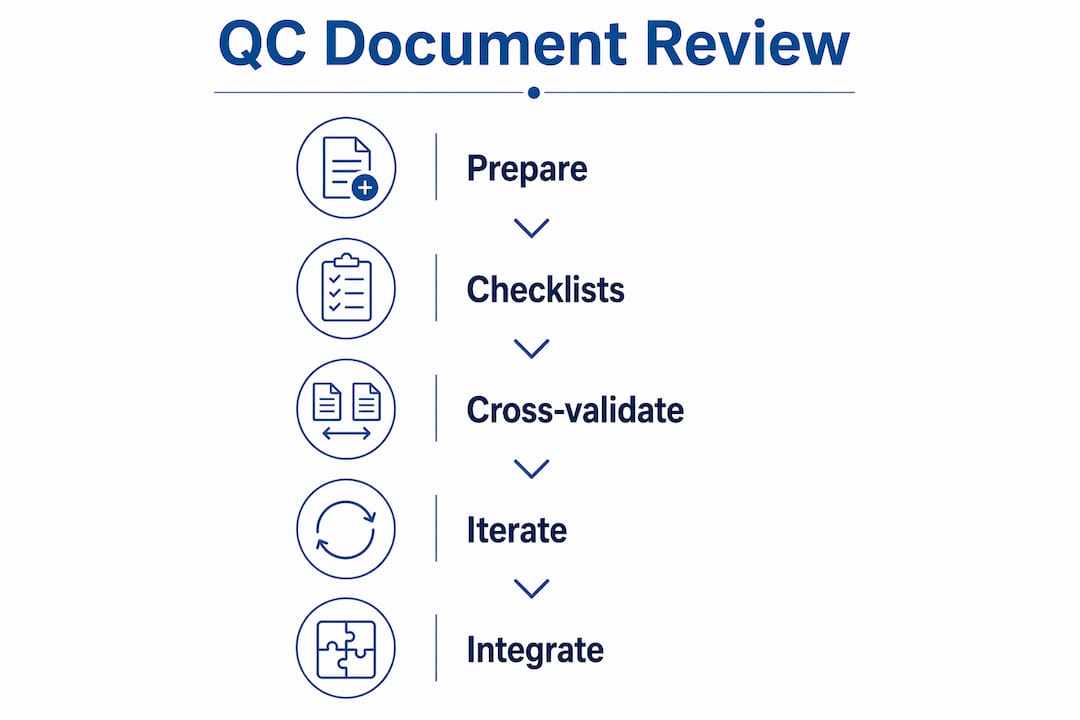
A well-built checklist maps directly to your document types and compliance criteria. Each row addresses one verification point. Each column captures the result, the reviewer, and the date. The structure matters because it creates an audit trail for your own review process.
A practical checklist for evaluating supplier QC covers these numbered steps:
- Confirm document version control. Every document must carry a revision number and an effective date. No version control means no change history.
- Verify certification scope and expiry. An ISO 9001 certificate must list the specific facility and scope. A certificate covering a different site is not valid for your supplier.
- Cross-check COA test methods against purchase order requirements. The test method on the COA must match what your purchase order specifies.
- Review CAPA closure rates. Open CAPAs older than 90 days signal a supplier that documents problems but does not resolve them.
- Confirm SQAA alignment. Check that the supplier’s documented KPIs match the targets in the signed SQAA.
Iterative review cycles improve accuracy significantly. Complex documentation reviews typically require 2–3 feedback cycles to reach acceptable accuracy. Stop iterating when your correction rate drops below 15% of reviewed documents. Continuing beyond that point adds time without meaningful accuracy gains.
| Checklist category | What to verify |
|---|---|
| Version control | Revision number, effective date, approver signature |
| Certification validity | Scope, facility address, expiry date |
| COA completeness | Test method, acceptance criteria, lot number |
| CAPA status | Root cause documented, closure date, verification step |
| SQAA alignment | KPIs match contract, review frequency confirmed |
Pro Tip: Integrate your checklist into your ERP or supplier management system. A checklist that lives in a spreadsheet gets lost. One embedded in your workflow gets used.
How do you identify discrepancies and verify document authenticity?
Pre-audit document review identifies baseline discrepancies before a site visit, and those findings often determine the audit outcome before you arrive. QA professionals who skip this step spend their on-site time discovering what a desk review would have caught in an afternoon.
The most reliable red flags for fabricated or audit-tailored documents include:
- Uniform handwriting across multiple records. Real production logs are filled in by different operators at different times. Consistent handwriting suggests one person completed all records at once.
- Clustered document dates. If a supplier’s inspection records, training logs, and calibration certificates all carry dates from the same two-week window, they were likely created together for your audit.
- Discrepancies between procedures and records. The written procedure says inspections happen every four hours. The records show inspections every eight hours. One of them is wrong, and neither is reliable until the supplier explains the gap.
- Missing traceability links. A COA that cannot be traced to a specific production batch, instrument, or analyst is not a controlled document.
Cross-validation is the most effective verification method. Compare the supplier’s documented procedures against their actual production records. Then compare both against the results from any previous third-party audit. Gaps between these three sources reveal where documentation diverges from reality.
Effective certificate review matches test methods to contract criteria rather than accepting a surface-level pass result. A supplier who passes their own internal test using a method your purchase order does not recognize has not met your requirements. They have met theirs.
When should you evaluate supplier quality performance based on document review?
Document review is not a one-time event at supplier onboarding. It feeds into a continuous supplier quality assessment cycle with defined timing and metrics.
The recommended sequence runs as follows:
- Pre-qualification review. Conduct a full document review before approving a new supplier. This establishes the baseline against which all future performance is measured.
- Post-contract review at 90 days. Check that the supplier’s operational records match their pre-qualification documents. Early deviations are easier to correct than entrenched ones.
- Annual performance review. Best practice supplier qualification requires a formal performance evaluation after 12 months. This review should assess documentation quality alongside operational metrics.
The key metrics that connect document review to supplier performance include:
- PPM (parts per million defect rate): A rising PPM with clean documentation signals that records are not reflecting actual production quality.
- OTIF (on-time in-full delivery rate): Chronic OTIF failures often trace back to process gaps that documentation review would have flagged earlier.
- CAPA effectiveness rate: Measure the percentage of closed CAPAs where the root cause did not recur within 180 days.
- Documentation compliance score: Track the percentage of submitted documents that pass your checklist without requiring revision.
Update your SQAA whenever a supplier’s performance metrics shift significantly. An agreement written at onboarding may not reflect current production volumes, new product lines, or changed regulatory requirements. Treating the SQAA as a living document, rather than a signed-and-filed artifact, keeps your quality expectations current.
Key Takeaways
Systematic document review, structured checklists, and defined performance timelines are the three pillars of effective supplier quality assurance.
| Point | Details |
|---|---|
| Start with the right documents | Quality manuals, COAs, CAPA records, and SQAAs form the minimum required document set. |
| Use structured checklists | Standardized checklists reduce document errors by up to 70% and create a defensible audit trail. |
| Verify authenticity, not just content | Check for uniform handwriting, clustered dates, and mismatches between procedures and records. |
| Match COAs to purchase order criteria | A pass result means nothing if the test method does not match your contract requirements. |
| Review performance on a defined schedule | Conduct pre-qualification, 90-day, and 12-month reviews to track documentation quality over time. |
Why most QA teams review documents too late
The most common mistake I see in supplier quality programs is treating document review as a pre-audit formality rather than a primary control. Teams schedule a supplier visit, request documents 48 hours before arrival, and then spend their on-site time reacting to what the documents reveal. That sequence is backwards.
SQA is proactive defect prevention, not reactive defect catching. The document review should happen weeks before any site visit, and its findings should drive the audit agenda. If a supplier’s CAPA records show 12 open items older than 90 days, you already know where to focus your time on-site. You do not need to discover that in a conference room.
There is also a persistent confusion between Quality Control and Quality Assurance that undermines review programs. QC is document-level accuracy verification. QA is process-level evaluation. Both matter, but they answer different questions. A supplier can have perfect documents and a broken process. The document review tells you what they claim. The audit tells you what they do. You need both, in that order.
The teams that get the most value from document review treat it as a decision-making tool, not a compliance checkbox. They use checklist findings to set SQAA terms, prioritize audit depth, and flag suppliers for more frequent monitoring. That approach turns a paperwork exercise into a genuine risk management function.
— Paul
Novatherix and verified quality documentation
QA professionals who work with research-grade compounds know that documentation quality directly affects research validity. Novatherix Laboratories publishes third-party tested COAs for every compound, with 99%+ purity verification and full test method disclosure. That level of transparency is exactly what a rigorous document review process demands from any supplier.
Every Novatherix COA includes the test method, acceptance criteria, lot number, and third-party laboratory reference, giving QA teams the complete documentation package that a checklist-based review requires. Professionals who need verified, traceable documentation for research compounds can review the full certificate of analysis standards Novatherix applies to every product batch.
FAQ
What is supplier quality control documentation?
Supplier quality control documentation is the set of records, certificates, and agreements that verify a supplier meets defined quality standards. It includes COAs, ISO certifications, CAPA records, audit reports, and supplier quality assurance agreements.
How often should you review supplier quality documents?
Conduct a full review at pre-qualification, again at 90 days post-contract, and then annually. Best practice calls for a formal 12-month performance evaluation tied to documented quality metrics.
What are the biggest red flags in supplier documents?
Uniform handwriting across multiple records, clustered document dates, and discrepancies between written procedures and operational records all signal documents created for an audit rather than during normal production.
What is the difference between QC and QA in document review?
Quality Control is document-level accuracy verification. Quality Assurance is process-level evaluation. Document review is a QC function; supplier audits are a QA function. Both are necessary and serve different purposes.
How do checklists improve document review accuracy?
Standardized checklists reduce document error rates by up to 70% by forcing consistent verification criteria across every review. Iterative review cycles, typically 2–3 rounds, further improve accuracy until the correction rate falls below 15%.
Recommended
- Returns & Refunds – Novatherix Laboratories
- Research Preparation & Reconstitution Guide – Novatherix Laboratories
- FL3 Print Package – Novatherix Laboratories
